The best bit for drilling tile depends on the tile material, hole size, and drill you plan to use. Diamond bits are options for hard tile, porcelain, and stone, while carbide-tipped masonry bits offer a versatile choice for tile and other materials. The Tavire set is best for buyers seeking diamond bits in several common sizes; the TITGGI and DYRECELVE sets are better for mixed-material drilling; and DECKRKAT and KURSTOL offer alternative diamond or carbide-tipped assortments.
| Set | Bit type | Best suited for |
|---|---|---|
| Tavire | Diamond and carbide | Hard tile and varied hole sizes |
| TITGGI | Carbide-tipped masonry | Multiple materials and sizes |
| DYRECELVE | Carbide-tipped masonry | Step-up drilling with a standard drill |
| KURSTOL | Carbide-tipped core bits | Quick-fit shank and larger holes |
| DECKRKAT | Dry diamond | Tile, porcelain, and stone |
Tavire Dry Diamond Drill Bit Set

Best for: People drilling hard tile, ceramic, glass, or stone who want several bit sizes. The set lists diamond bits in 1/4, 5/16, 3/8, and 1/2 inch, plus 1/4-inch Ti and tungsten carbide bits.
The hex shank is described as providing anti-slip grip and torque transfer. The product information also cites vacuum brazing and an AISI 5140 alloy-steel body. This mix of bit types and sizes makes the set a useful option when the project calls for more than one hole diameter.
Limitation: The listed diamond sizes begin at 1/4 inch, so this set may not suit a project requiring smaller holes.
TITGGI 10-Piece Carbide Masonry Set

Best for: Buyers who need carbide-tipped bits for tile and a range of other materials, including glass, cement, brick, wood, and plastic. The set has a listed size range from 1/8 to 1/2 inch and includes a three-flat shank.
Its dual U-groove design is intended to remove drilling dust, and the three-flat shank is designed to sit securely in a compatible drill chuck. Several listed pieces are 1/4 inch, which can be useful when that is the required diameter or a spare is desirable. This broad material and size range makes it a flexible general-purpose pick.
Limitation: The listed size inventory repeats 1/4-inch bits and does not include every size between 1/8 and 1/2 inch.
DYRECELVE 12-Piece Masonry Bit Set

Best for: DIY users who want a carbide-tipped set with repeated sizes for pilot and step-up drilling. The assortment includes 1/8, 5/32, 3/16, 1/4, 5/16, 3/8, and 1/2-inch bits. Its spear-shaped tips and spiral flutes are designed to cut and carry loosened material along the bit.
The three-flat shank fits compatible keyed or keyless three-jaw chucks, according to the product details. Choose this set if you want multiple 1/4-inch bits and a clearly specified size count for a standard drill.
Limitation: The listed shank is not intended for SDS rotary hammers or 1/4-inch impact-driver collets. The product also advises matching speed, pressure, and cooling to the surface.
KURSTOL 10-Piece Carbide Core Set

Best for: Buyers who want carbide-tipped bits with a quick-fit shank for drilling materials listed as ceramic tile, brick, wood, and plastic. The set includes 1/4, 5/16, 3/8, and 1/2-inch sizes, with repeated pieces in some diameters.
The product describes tungsten carbide tips welded to a high-strength steel substrate. Its cross-shaped head is intended to reduce slipping and walking, while the spiral groove helps remove chips. The stated recommended speed is 2,000 to 5,000 RPM, with a maximum of 5,000 RPM.
Limitation: The size assortment starts at 1/4 inch, so it is not the choice for smaller pilot holes. Follow the stated speed guidance rather than assuming it suits every drill or surface.
DECKRKAT Dry Diamond Tile Bit Set
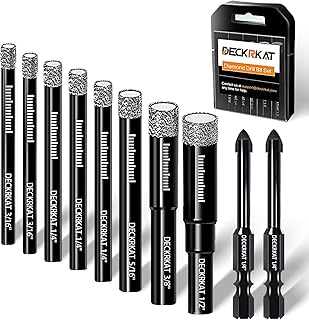
Best for: People drilling tile, porcelain, ceramic, marble, granite, glass, or stone who want dry diamond core bits. The set includes sizes from 3/16 to 1/2 inch, with several repeated sizes.
The listed design features include vacuum-brazed diamonds, side flutes for debris removal, and depth marks. The product describes an internal wax lubricant and an integrated cooling system, and recommends pausing to cool the bit after each hole. This makes the set a relevant option when a dry-drilling design is a priority.
Limitation: The product information specifically says these bits are not for wood. It also recommends cooling pauses, so continuous drilling without breaks is not the described use.
Buying Guide: How To Choose A Tile Drill Bit
Should you choose diamond or carbide?
Look at the tile and the product’s stated material range before choosing. Diamond sets in this comparison name porcelain, stone, glass, or hard tile among their intended materials. Carbide-tipped masonry sets list tile alongside materials such as cement, brick, or wood. Do not assume that every bit works equally well on every surface just because a broad material list is provided.
Which size and shank do you need?
Match the bit diameter to the required hole, then check the shank against your drill’s chuck. Sets that include smaller diameters can help with pilot holes or step-up drilling. Shank types are not interchangeable in every tool: DYRECELVE, for example, specifies standard three-jaw chucks and excludes SDS rotary hammers and 1/4-inch impact-driver collets.
What should you know about drilling technique?
Follow the bit maker’s instructions for speed, pressure, and cooling. The listed sets describe different designs, including dust-removing flutes and dry-drilling features, but those details do not replace surface-appropriate technique. Check the package directions before starting, particularly when drilling brittle tile, and use a bit intended for the material.
Frequently Asked Questions
What type of bit is used to drill tile?
Diamond and carbide-tipped bits are both represented in these sets. Choose based on the tile material, required hole size, and the manufacturer’s stated applications.
Can a masonry bit drill ceramic tile?
Some carbide-tipped masonry bits in this comparison list ceramic or tile as compatible materials. Verify the specific product’s material guidance before use.
Is a diamond bit better for porcelain?
Several diamond sets here specifically list porcelain. Compare the bit’s size range and drilling instructions with the requirements of your project.
Do all tile bits fit a standard drill?
No. Check the shank and your drill’s chuck. The DYRECELVE set specifies compatible three-jaw chucks and is not for SDS rotary hammers or 1/4-inch impact-driver collets.
Should you use water with a dry diamond bit?
DECKRKAT describes its bits as designed for dry drilling and recommends pausing to cool them after each hole. Follow the instructions supplied with the specific bit you choose.