The best electric sander for a deck depends on whether you are smoothing broad boards, controlling dust, or reaching corners and edges. These five corded sanders are compact tools suited to smaller deck sections, spot repairs, and detail work; none is a dedicated floor or deck sander for covering a large surface quickly. The SKIL SR211601 is best for variable-speed sanding with a cyclonic dust box, while the DEWALT DWE6423 offers a 3-amp motor and vibration-reducing design. The detail sander is the better choice for tight areas.
| Product | Best For | Notable Feature |
|---|---|---|
| SKIL SR211601 | Variable-speed general sanding | Cyclonic dust collector |
| DEWALT DWE6423 | Comfort during sanding | Separate counterweight design |
| HYCHIKA 5-Inch Sander | Speed options and included abrasives | Six speeds and 12 sandpapers |
| MAXXT Random Orbital Sander | Adjustable control and reduced vibration | Brushless motor and pad braking |
| SKIL Detail Sander | Corners and contours | Three interchangeable attachments |
SKIL SR211601 Random Orbital Sander

Best for: Homeowners who need variable speed for different sanding stages on deck boards or smaller repair areas. Its 2.8-amp motor runs at 13,000 orbits per minute, and the speed control lets users adjust power for different materials.
The X-flow dust collector uses cyclone force to gather debris in a transparent container that is easy to empty. That makes dust collection a useful built-in feature for localized work, although collection does not eliminate the need for appropriate dust protection and cleanup.
Limitation: This is a 5-inch handheld sander, so it is better for spot work than sanding an entire deck efficiently. Choose it if variable speed and an easy-to-empty dust box matter more than a larger sanding footprint.
DEWALT DWE6423 Variable-Speed Sander
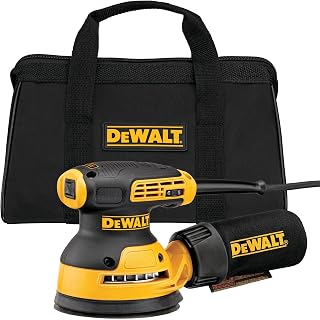
Best for: Buyers who prioritize controllable speed and reduced vibration during handheld sanding. Its 3-amp motor operates from 8,000 to 12,000 OPM, giving users a range for adjusting the sanding rate.
The separate counterweight design is intended to reduce vibration and improve comfort. A dust-sealed switch helps protect the switch from dust ingestion. These details make this model a practical option for repeated sanding sessions on deck sections and wood repairs.
Limitation: The listed features do not specify an included dust container or sandpaper. Check what accessories are supplied and plan for dust collection before starting. It remains a compact 5-inch tool, not a fast solution for a large deck.
HYCHIKA 5-Inch Six-Speed Sander

Best for: Buyers seeking several speed settings and included sanding sheets for woodworking and finishing tasks. The 300W motor has six speed settings and a stated maximum output of 13,000 RPM. The package includes 12 sandpapers.
Its eight vacuum holes feed a dust bag, and the product description emphasizes a large-capacity collector. The textured rubber grip is designed to support one-handed control and reduce fatigue. These features can help with localized deck sanding where control and dust handling are priorities.
Limitation: The claimed dust-collection percentage and runtime capacity are manufacturer-stated figures, not a guarantee for every deck or sanding condition. Avoid choosing it solely on those claims; consider the six-speed control, included abrasives, and handheld size.
MAXXT Brushless Random Orbital Sander

Best for: Users who want multiple ways to adjust sanding speed and value vibration management. This model has an EC brushless motor, two speed-control modes, and six fixed speed levels in one mode. The listed package includes a 6-inch sanding pad and 10 sanding papers.
Electronic braking control is designed to stop the pad nearly instantly. The manufacturer also describes the motor as reducing vibration transferred to the hand. For deck work, the larger listed pad may cover more area per pass than a 5-inch model, while remaining a handheld tool.
Limitation: The product name specifies a 5 mm orbit, but the supplied features do not list a full operating-speed range. Confirm that the pad size and sanding-paper supply suit the intended task before selecting it.
SKIL Multi-Function Detail Sander

Best for: Deck owners who need to sand corners, edges, or contoured areas that a round orbital pad may not reach well. The 1.2-amp motor runs at 13,500 orbits per minute, and the tool includes three additional detail attachments for different surface shapes.
The attachments change without tools. Dust management includes a micro-filtration system and a 1-1/4-inch dust port for vacuum attachment, so users can choose between the dust box and a compatible vacuum connection.
Limitation: Its detail-focused design is not the best fit for broad, flat deck boards. Choose this as a complement for edges and tight areas rather than as the only sander for a large deck.
Buying Guide: Choosing An Electric Sander For A Deck
Should you use a handheld sander for the whole deck?
A 5-inch or detail sander is most practical for small deck sections, repairs, edges, and localized surface preparation. Sanding a large deck board by board with a compact tool can be slow. For a whole-deck project, compare larger floor or deck sanding equipment and follow the coating or stain manufacturer’s preparation instructions.
Which sanding shape and pad size are useful?
Random orbital models are suited to general smoothing on accessible, relatively flat areas. A detail sander is better for corners and contours. A larger pad can cover more area per pass, but confirm that compatible abrasives are available and that the tool’s size is manageable for the job.
How important are speed control and dust collection?
Variable speed gives more control when changing materials or sanding stages. Dust containers and bags simplify collection, while a vacuum port can offer another collection option when provided. No listed dust system guarantees a dust-free workspace, so use suitable protective equipment and clean the work area.
What should you check before sanding deck boards?
Inspect the boards for loose fasteners, damaged wood, and peeling finish before sanding. Select abrasives appropriate to the existing surface and the next finish, and test a small area first. Keep the sander moving to reduce the risk of uneven spots, and check the tool instructions for safe operation.
Frequently Asked Questions
What type of electric sander is best for deck boards?
A random orbital sander is a versatile choice for localized smoothing on flat boards. For an entire deck, a larger dedicated sanding machine may be more efficient.
Can a detail sander sand a whole deck?
It can sand wood, but its small, pointed attachments are designed for corners, edges, and contours. It is generally better as a detail tool than as the primary sander for broad boards.
Does a dust bag remove all sanding dust?
No. Dust bags and containers collect debris, but the listed features do not establish dust-free operation. Use appropriate protection and cleanup practices.
Is variable speed useful for deck sanding?
Variable speed allows the user to adjust the sanding rate for different materials and tasks. It can offer more control, but the appropriate setting depends on the surface and abrasive.