The best laser for leveling floors depends on whether you need a simple 90-degree tile guide or room-wide reference lines. The PREXISO is designed for floor and tile layouts, while the CIGMAN and Takamine project multiple 360-degree planes for broader renovation work. The two WEIDDW listings offer green cross-line projection for interior projects; their supplied feature descriptions are identical.
| Product | Best suited for | Key distinction |
|---|---|---|
| PREXISO Square Laser | Tile and floor layouts | 90-degree lines, 30-foot range |
| CIGMAN 4 x 360° Laser | Room-wide renovation work | Four planes, app and remote |
| Takamine 16 Line Laser | Floor-to-ceiling layouts | Low ground line and mounting options |
| WEIDDW Laser Level, listing one | Interior decorating and tiling | Two included batteries |
| WEIDDW Laser Level, listing two | Similar interior tasks | Same listed features, separate listing |
PREXISO Square Laser For Tile Layouts
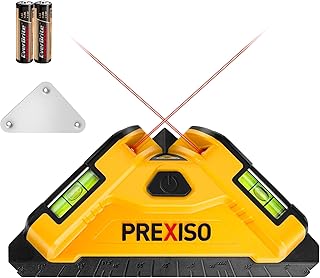
The PREXISO is best for homeowners or installers who need a straightforward floor-level layout guide, particularly for arranging tile in square patterns. It projects red laser lines at an exact 90-degree angle and has a stated working distance of 30 feet.
Two bubble vials support positioning, and the alignment guide helps calculate and turn angles in 5-degree increments. Its magnetic base attaches to metal surfaces, while the included leveling plate supports use in other positions, including on a wall or inclined surface. Two AA batteries are included.
Limitation: Its listed range is 30 feet, so it may be less suitable than a longer-range tool for large rooms. Choose it for floor and tile layout rather than extensive room-wide coverage.
CIGMAN 4 x 360° Laser Level

The CIGMAN is best for users who want reference lines across floors, walls, and ceilings during a larger renovation. Its four 360-degree planes create 16 green laser lines, and the horizontal and vertical planes intersect at 90 degrees for square layouts.
Listed accuracy is ±1/8 inch at 33 feet, with an indoor working range up to 100 feet. It self-levels within ±3 degrees and also offers manual mode for angled projections. The rechargeable 4,000mAh battery, USB-C charging, app, remote, and four brightness settings provide several ways to operate and adjust the tool.
Limitation: Pulse mode can extend the range to 164 feet only with a compatible receiver, which is not included. Choose this model if you need multiple planes and controls; account for the separate receiver if extended pulse-mode use matters.
Takamine 16 Line Laser For Floor And Ceiling

The Takamine is best for users who need floor-to-ceiling coverage and flexible mounting. Its four 360-degree planes include two horizontal and two vertical planes. The manufacturer describes a ground-level horizontal line that reaches 1/2 inch and a top line that reaches 4 inches from the top surface, useful details for planning low or overhead references.
It has a rotating base and a 1/4-inch mounting thread, plus 1/4-20 and 5/8-11 threads on the base. A supplied adjustable bracket can attach magnetically or with screws. Listed accuracy is ±1/9 inch at 33 feet, and the stated range is up to 130 feet under 100-lux conditions.
Limitation: The 200-foot outdoor pulse-mode range requires a Takamine receiver. Choose this if mounting flexibility and multiple planes matter; check receiver needs for strong-light or outdoor work.
WEIDDW 360° Green Laser Level, Listing One

This WEIDDW listing is best for interior users handling tasks such as decoration, picture hanging, tiling, or ceiling installation. Its product name identifies it as a 360-degree green cross-line self-leveling laser, and the supplied feature list also mentions engineering measurement.
It includes two 2,400mAh batteries. Each is listed for three to four hours of continuous use, for a stated combined use time of six to eight hours. The listing also describes a 12-month free warranty for users who purchase WEIDDW products.
Limitation: The provided features do not specify measurement accuracy or working range. Choose it for the listed interior applications, but verify those specifications if your floor project depends on a particular tolerance or distance.
WEIDDW 360° Green Laser Level, Listing Two

This separate WEIDDW listing is also best for general indoor layout tasks, including tiling, ceiling installation, and decoration. Its supplied description matches the other WEIDDW listing: a 360-degree green cross-line self-leveling tool with two 2,400mAh batteries and a stated total of six to eight hours of use.
The shared feature list gives each battery a three-to-four-hour continuous-use estimate and mentions a 12-month free warranty. The separate listing may help shoppers compare the product presentation, but the supplied information does not identify a different technical advantage over the other WEIDDW option.
Limitation: No accuracy or working-range figure is provided in the supplied product details. Compare the listing’s current specifications before choosing it for precision-sensitive floor work.
Buying Guide: How To Choose A Floor-Leveling Laser
Do you need a tile square or full-room coverage?
A 90-degree floor laser is useful for establishing perpendicular layout lines when setting tile. The PREXISO specifically lists a 90-degree projection and 30-foot range. A multi-plane 360-degree laser is better for carrying references around a room and onto walls or ceilings. The CIGMAN and Takamine list four 360-degree planes.
What accuracy and distance do you need?
Check the stated accuracy at its matching distance, not as a standalone number. CIGMAN lists ±1/8 inch at 33 feet, and Takamine lists ±1/9 inch at 33 feet. The supplied WEIDDW details do not give accuracy or working range. For a large area or tight layout tolerance, confirm that the tool’s specifications meet the project requirements.
Will you work in bright conditions or outdoors?
Bright light can make a laser line harder to see. CIGMAN and Takamine list pulse modes for use with a compatible receiver, but the receiver is not included in the CIGMAN description, and Takamine’s extended outdoor range requires its receiver. Check receiver requirements before relying on an extended range.
How will you mount and power the tool?
Consider whether the tool needs to sit on the floor, attach to metal, or mount on a tripod or bracket. PREXISO lists a magnetic base and leveling plate; Takamine lists several mounting threads and an adjustable bracket. For longer sessions, compare battery type and stated runtime: WEIDDW lists two batteries, while CIGMAN lists a rechargeable battery and USB-C charging.
Frequently Asked Questions
Can a laser level help lay floor tile?
Yes. A laser can provide straight reference lines or a square layout guide. PREXISO specifically lists tile laser projection and 90-degree lines; multi-plane models can provide broader room references.
Is a 360-degree laser necessary for leveling a floor?
No. A 90-degree floor laser may be sufficient for establishing tile layout lines. A 360-degree model is more useful when you also need lines around walls or across ceilings.
Does a laser level physically level the floor?
No. A laser level projects a reference line to help identify level or layout positions. It does not smooth, raise, or lower the floor surface.
Which listed models specify accuracy?
CIGMAN lists ±1/8 inch at 33 feet, and Takamine lists ±1/9 inch at 33 feet. The supplied feature details for PREXISO and WEIDDW do not state an accuracy figure.
Do the extended-range modes include a receiver?
The CIGMAN listing says its compatible receiver is not included. The Takamine listing says its extended outdoor pulse-mode range uses a Takamine receiver.