The best sliding miter saw blade depends on your saw’s diameter and arbor, the material you cut, and the finish you need. For a 10-inch saw, the Freud LU91R010 offers a 60-tooth thin-kerf option. For 12-inch saws, choices include the Freud LU91R012 and LU91M012, the 80-tooth CMT 285.680.12, and the CMT P12072S. Check your saw’s requirements before selecting any blade.
| Blade | Best For | Key Detail |
|---|---|---|
| Freud LU91R010 | 10-inch saws | 60 teeth; 5/8-inch arbor |
| Freud LU91R012 | 12-inch saws needing a thin kerf | 72 teeth; negative hook angle |
| CMT 285.680.12 | Fine-finish crosscuts | 80 teeth; 1-inch bore |
| Freud LU91M012 | General 12-inch crosscutting | 72 teeth; 1-inch arbor |
| CMT P12072S | Mixed sheet goods and wood | 72 teeth; 1-inch bore |
Freud LU91R010 10-Inch Thin-Kerf Blade
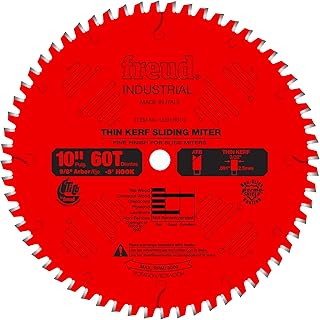
The Freud LU91R010 is a 10-inch blade with 60 ATB teeth, a 5/8-inch arbor, and a .090-inch kerf. Its listed negative 5-degree hook angle is designed to minimize climbing and support controlled cutting. The manufacturer also specifies a TiCo high-density carbide crosscutting blend.
Best for: Owners of compatible 10-inch sliding compound miter saws who want a thin-kerf blade for crosscutting. It was selected as the list’s 10-inch option, with tooth geometry and hook angle stated clearly.
Check first: This blade has a 5/8-inch arbor. Do not assume it fits a saw with a different arbor requirement.
Freud LU91R012 12-Inch Thin-Kerf Blade

This Freud blade measures 12 inches and has 72 teeth with an ATB grind. Its 5-degree negative hook angle is described as helping push the workpiece down and toward the fence, while the thin-kerf design removes less material and requires less horsepower than a standard kerf blade for comparable results.
Best for: Users with a compatible 12-inch saw who want a crosscutting blade with a thin kerf and a stated control-focused hook angle. The TiCo carbide blend is specified for cutting performance, edge retention, and durability.
Check first: The supplied product details do not state the arbor size. Confirm the blade’s bore matches your saw before buying.
CMT 285.680.12 80-Tooth Fine-Finish Blade

The CMT 285.680.12 is a 12-inch blade with 80 ATB teeth, a 1-inch bore, and a .091-inch kerf. Its listed uses include fine-finish crosscuts in softwood, hardwood, plywood, and chipboard, as well as molding and picture frames. The 5-degree negative hook angle is described as limiting splintering and climbing.
Best for: Woodworkers prioritizing fine-finish crosscuts or trimming molding and picture-frame stock. Its 80 teeth make it the highest-tooth-count choice in this selection.
Check first: Verify that your saw takes a 12-inch blade with a 1-inch bore; tooth count alone does not establish compatibility.
Freud LU91M012 12-Inch 72-Tooth Blade

The Freud LU91M012 has a 12-inch diameter, 72 ATB teeth, a 1-inch arbor, and a .090-inch kerf. Its TiCo high-density carbide crosscutting blend is specified for performance, and the negative 5-degree hook angle is intended to minimize climbing for better control.
Best for: Buyers who want a clearly specified 12-inch Freud blade and need a 1-inch arbor. It offers a useful middle ground between the 60-tooth 10-inch option and the 80-tooth CMT fine-finish blade.
Check first: Confirm your saw accepts a 12-inch blade and the listed 1-inch arbor.
CMT P12072S ITK Plus Finish Blade

The CMT P12072S is listed as a 12-by-72-tooth ATB blade with a 1-inch bore. Its stated materials include hardwood, MDF, melamine, molding, plywood, and softwood, and its listed machines include miter saws and sliding miter saws.
Best for: Buyers who cut several types of wood and sheet goods and want one listed blade for those materials. It was selected for its broad material list and 72-tooth configuration.
Check first: The supplied features do not specify kerf thickness or hook angle, so consult the full product specifications if either detail is essential to your setup.
Buying Guide: How To Choose A Sliding Miter Saw Blade
Which blade diameter and arbor should I choose?
Match both the blade diameter and the arbor to your saw’s manual or existing blade. The products here include 10- and 12-inch diameters, with listed arbor or bore sizes of 5/8 inch or 1 inch. A blade that has the wrong diameter or bore is not a suitable choice just because its tooth count or brand is appealing.
How many teeth are appropriate?
Tooth count is one comparison point, not a guarantee of cut quality. The options here range from 60 to 80 teeth. The 80-tooth CMT 285.680.12 is specifically described for fine-finish crosscuts; the 72-tooth options offer other combinations of material coverage, arbor details, and blade design. Consider the cut and material you make most often.
What does thin kerf mean?
A thin-kerf blade removes less material than a standard-kerf blade. The Freud LU91R010 and LU91R012 are identified as thin kerf, and the LU91M012 lists a .090-inch kerf. Thin kerf can require less horsepower for comparable results, according to the LU91R012 product details.
Why do hook angle and grind matter?
All five listed blades specify an ATB grind or are identified as ATB. The Freud blades and CMT 285.680.12 list a negative 5-degree hook angle. Product details associate this angle with less climbing or splintering and better control. Compare these specifications with the intended use and your saw’s requirements.
Frequently Asked Questions
Can I use a 12-inch blade on a 10-inch saw?
No. Select the blade diameter specified for your saw. These products include separate 10- and 12-inch options.
Is a higher tooth count always better?
No. Tooth count should be considered alongside the material, desired finish, and blade specifications. The 80-tooth option is explicitly described for fine-finish crosscuts, but that does not make it the right choice for every task.
What is the difference between the Freud LU91R012 and LU91M012?
Both are 12-inch, 72-tooth Freud blades with ATB grind and a negative 5-degree hook angle. The LU91M012 lists a 1-inch arbor and .090-inch kerf; the supplied LU91R012 details emphasize thin-kerf design but do not state its arbor size.
Which option is listed for MDF and melamine?
The CMT P12072S feature list names MDF and melamine, along with hardwood, plywood, molding, and softwood.