The best water pump to increase pressure depends on where you need stronger flow. For whole-home pressure, the AQUASTRONG Smart 45 offers adjustable, variable-speed boosting; the 550W Benut model is another whole-house option. For garden hoses, RVs, and washdown tasks, the ECO-WORTHY and TDRFORCE diaphragm pumps provide on-demand operation in smaller flow ranges. Match the pump’s pressure and flow specifications to your water source, intended use, and installation requirements.
| Product | Best For | Listed Pressure | Listed Flow |
|---|---|---|---|
| AQUASTRONG Smart 45 | Whole-house boosting | 22–80 PSI adjustable | Up to 1,500 GPH |
| Benut 550W Booster | Whole-house flow demand | Up to 72 PSI | Up to 22.9 GPM |
| ECO-WORTHY 33-Series | Compact utility and garden use | 45–70 PSI adjustable | 4.0 GPM |
| ECO-WORTHY 5.5 GPM | On-demand hose and RV use | 70 PSI | 5.5 GPM |
| TDRFORCE 540E | Higher-pressure hose and washdown tasks | Up to 75 PSI | 5.5 GPM |
AQUASTRONG Smart 45 Whole-House Booster

Best for: Homeowners seeking adjustable pressure across multiple household taps. The Smart 45 automatically responds to water demand and uses variable-speed control to maintain pressure. Its adjustable range is 22–80 PSI, with a 44 PSI preset, and its listed maximum flow is 1,500 GPH.
The integrated design includes a stainless steel impeller, maintenance-free pressure tank, stainless steel connectors, and an outlet check valve. The manufacturer lists operation with water temperatures up to 175°F and typical-use noise of 55 dB(A). It was selected for its whole-house focus and broad pressure adjustment range.
Limitation: Its maximum flow and pressure are specifications, not guarantees of performance at every installation. Check the water supply and installation needs before choosing a system-wide booster.
Benut 550W Automatic Whole-House Pump

Best for: Buyers comparing whole-house pumps for several fixtures. The listed 550W, 110V motor is designed to provide up to 72 PSI, with maximum flow of 22.9 GPM and maximum head of 164 feet. The product description identifies showers, kitchen faucets, appliances, and outdoor irrigation as intended household uses.
This pump was selected as a higher-flow whole-house alternative to small diaphragm models. Its listed operating noise is 45 dB, which may matter when considering a garage, basement, or utility-room installation.
Limitation: The provided product details do not describe the pressure-control adjustment range or specific included fittings. Confirm setup requirements and suitability for your plumbing before purchase.
ECO-WORTHY 33-Series Diaphragm Pump
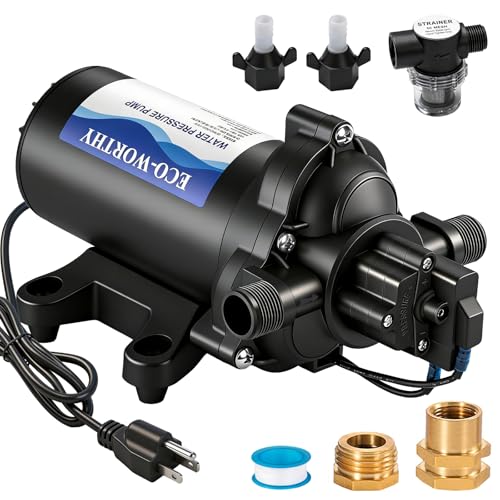
Best for: Garden, marine, and smaller water-transfer tasks where a 4.0 GPM flow rate is appropriate. This 110V AC diaphragm pump switches on when a faucet opens and off when it closes. Its pressure setting is adjustable from 45 to 70 PSI, and the listed self-priming height is up to 9.8 feet.
The pump includes garden-hose adapters and built-in thermal overload protection. It was selected for buyers who want an on-demand pump with a stated pressure adjustment range rather than a fixed setting.
Limitation: Its 4.0 GPM capacity is lower than the 5.5 GPM options below. Avoid choosing it if your application requires more flow than that listed maximum.
ECO-WORTHY 5.5 GPM On-Demand Pump

Best for: Users who need more listed flow than the 33-Series offers for garden hoses, irrigation, RVs, or similar applications. This 110V AC diaphragm pump provides up to 5.5 GPM and has a 70 PSI pressure switch. It self-primes up to 9.8 vertical feet and lists a maximum lift of 131 feet.
Its pressure switch starts water delivery when a faucet opens and shuts the pump off when the faucet closes. Thermal overload protection is also listed. Choose this model if on-demand operation and 5.5 GPM are a closer fit than the smaller ECO-WORTHY option.
Limitation: The listed 70 PSI is the switch setting, not a promise of that pressure at every outlet or flow rate. The provided details also specify a 1.6-amp maximum draw.
TDRFORCE 540E 5.5 GPM Booster

Best for: Garden hoses, boat washdown, and other fresh-water tasks where a 75 PSI maximum setting and 5.5 GPM flow are useful. The 110V pump is self-priming and has a listed maximum lifting height of 160 feet. Its 170W motor and on-demand design are specified for home, marine, and garden applications.
Included connection details list 3/4-inch male inlet and outlet fittings, a 1/2-inch male inlet connector, and a 4.3-foot power cord with a standard US plug. It was selected for its stated combination of flow, pressure, and installation details.
Limitation: The listed maximum pressure and lift should not be treated as simultaneous operating performance. Verify the required connections and installation position for your setup.
Buying Guide: How To Choose A Water Pressure Booster
Do you need pressure for the whole house or one outlet?
For multiple household fixtures, compare pumps described for whole-house boosting, such as the AQUASTRONG or Benut. Smaller on-demand diaphragm pumps are better suited to specific uses like a garden hose, RV water supply, or washdown task. Confirm that the pump type is appropriate for your water system before installation.
How much pressure and flow should you compare?
Pressure, measured in PSI, describes the force available; flow, measured in GPM or GPH, describes the volume delivered over time. Compare both figures with your intended use. A pump with a high maximum PSI may still have a flow limit, and the listed maximums may not occur together under actual conditions.
What should you check before installing?
- Confirm the available power supply, voltage, and electrical requirements.
- Check inlet and outlet sizes, hose or plumbing connections, and available space.
- Review priming height, lift specifications, water temperature limits, and whether the pump is intended for your water source.
- Consider automatic on-demand control, noise information, and overload protection where listed.
- Do not use these pumps to raise pressure beyond the limits of your plumbing or local requirements; consult a qualified professional if unsure.
Frequently Asked Questions
Can a water pump increase pressure in a house?
Yes. A booster pump can raise water pressure when the pump and installation are suited to the home’s water supply and plumbing. A whole-house model is generally more relevant than a small hose or RV diaphragm pump for multiple fixtures.
Is higher PSI always better?
No. The right pressure depends on the application and plumbing limits. Compare pressure alongside flow, pump controls, and the requirements of the water system.
What is the difference between a whole-house booster and a diaphragm pump?
A whole-house booster is intended to support household water demand across fixtures. The listed diaphragm pumps are compact on-demand options for more focused uses such as hoses, irrigation, RVs, or boat washdown.
Does self-priming mean a pump can draw water from any depth?
No. Self-priming does not mean unlimited suction depth. Check the product’s stated priming height and lift specifications, and confirm they match your installation.
Should I install a pressure booster myself?
Installation depends on the pump, plumbing, electrical supply, and local requirements. Follow the manufacturer’s instructions and consult a qualified plumber or electrician when the work or system requirements are unclear.